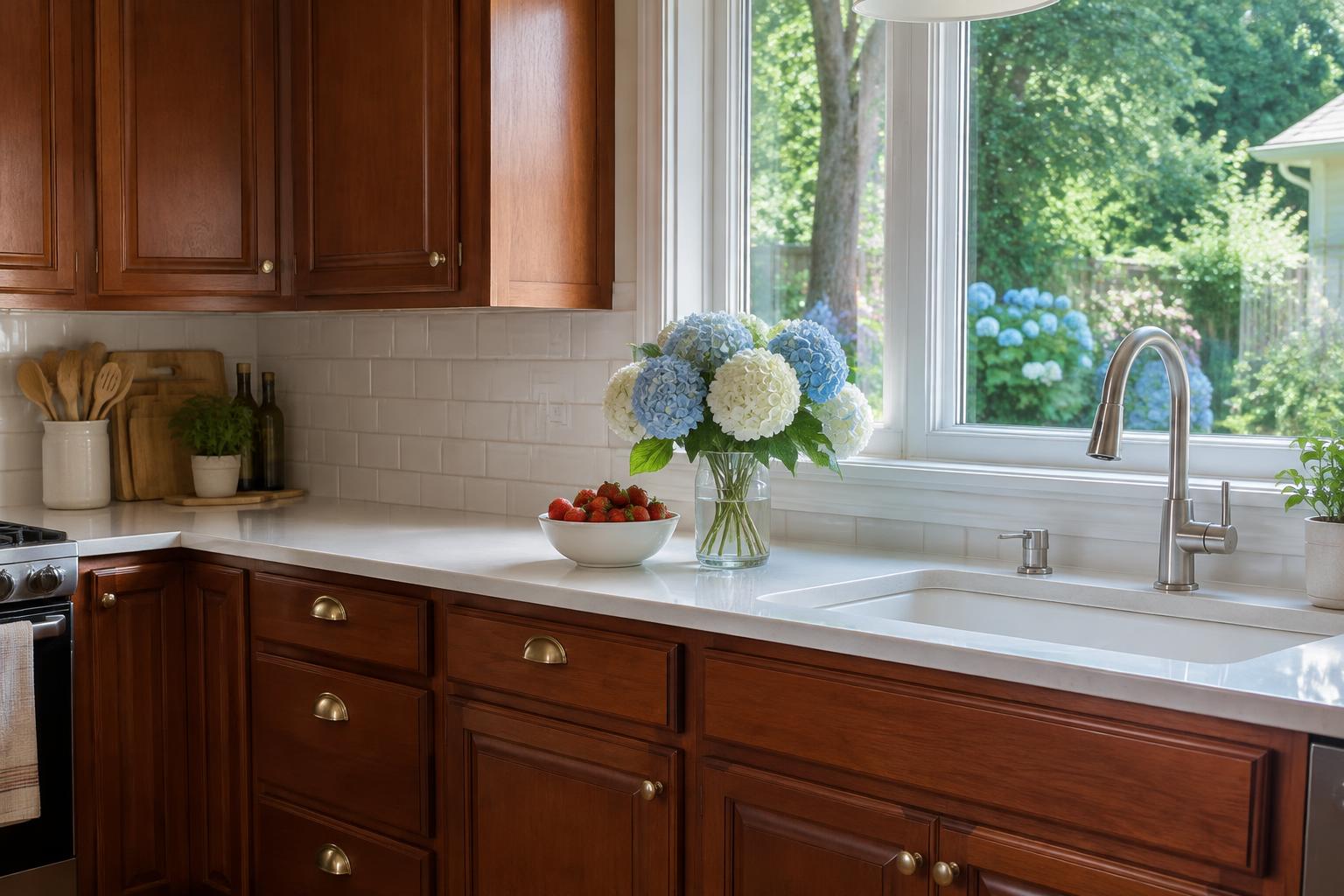
Assess the kitchen without its accessories
Early summer means long light, school schedules winding down and a natural window for planning work before the busy fall season.
Cherry cabinets and busy granite can make a Loudoun kitchen from the 1990s or 2000s feel visually heavy, especially when paired with ornate lighting and a contrasting backsplash. That does not establish which permanent components should go. Begin by clearing counters, removing temporary decorations and viewing the room in daylight and evening light. The combination may be the problem even when individual materials remain useful.
Identify the strongest sources of visual competition. The granite may contain several colors, while the backsplash introduces another pattern and the walls add an unrelated undertone. Separate those issues from practical complaints such as broken drawers or inadequate preparation space. A successful update should address both, but they do not necessarily require the same level of intervention.
01Inspect cabinets as working assemblies
Evaluate cabinet boxes, doors, drawers, hardware and layout separately. A sound exterior does not guarantee usable storage, and worn hardware does not automatically condemn the entire installation. Open every cabinet, inspect accessible interiors and note damaged areas. Ask a qualified cabinet professional what is repairable and what would remain compromised after refinishing or hardware replacement.
Then examine whether the arrangement deserves to survive. If the refrigerator blocks a doorway or the only preparation counter is too remote from the sink, a cosmetic refresh may preserve the kitchen’s main frustration. Conversely, a sensible layout with serviceable boxes may justify retention. Decide what keeping the cabinets would prevent as well as what it would save. Retention is strongest when it supports the future plan.
02Understand what refinishing can change
Do not assume every cherry kitchen can reach the same painted or stained appearance. The existing finish, wood condition and construction details affect the options. Request a sample using the proposed preparation and finish process rather than relying on a color chip. Review how grain, profiles and repaired areas will look, and ask what maintenance the resulting finish will require.
Painting changes color but not door shape, overlay relationships or the cabinet layout. If those are the features you dislike, paint may produce a cleaner version of an unsatisfying kitchen. Staining also has practical limits that should be demonstrated, not promised casually. Compare refinishing with selective replacement and full replacement using clearly described scopes. Each should state what is repaired, reused, altered and left as existing.
03Let retained granite set the palette
If the countertop is in good condition and the layout remains useful, consider designing around its actual colors. View it closely enough to distinguish the background from the flecks and veins. Choose a quieter backsplash and wall color that relate to that background rather than trying to match every accent. A patterned stone often needs fewer competing materials, not a more elaborate decorating scheme.
Evaluate large physical samples against the counter in several locations. Light from a window can make a combination appear different from the same materials beneath upper cabinets. If replacing cabinetry while retaining the stone, have specialists assess removal, support and reinstallation feasibility before assuming reuse is practical. Existing dimensions, seams and sink openings can constrain the new plan, and successful salvage should not be guaranteed.
04Use smaller changes where they matter
Hardware, lighting and wall finishes can shift the balance of a kitchen without replacing every major surface. Choose hardware that works with the retained doors and existing drilling pattern, or explicitly include the work needed to change it. Avoid selecting a fashionable handle that leaves unresolved holes or awkward proportions. Test a sample on an actual door before ordering the full quantity.
Lighting deserves a separate review. Better task illumination can make a dark working area more useful, while a less visually dominant decorative fixture can reduce clutter overhead. Check how the proposed lamps render the cabinet and stone colors. Do not use a brighter bulb as the only response to a poorly distributed lighting plan. The goal is comfortable visibility and a calmer hierarchy of surfaces.
Keep the components that remain sound and support a useful layout, then reduce visual competition around them rather than replacing materials solely because of their era.THE SAROKEY APPROACH
05Avoid partial updates that create stranded work
Sequence decisions around dependencies. Replacing a countertop now may be unwise if cabinet replacement is already likely soon. New flooring can become awkward if a future layout exposes areas that were not covered. A backsplash may need removal when the counter changes. Map those relationships before deciding that a smaller first phase is necessarily less wasteful.
Also consider appliances and service work. A retained cabinet opening may limit future choices, while a replacement range or hood may affect surrounding construction. Confirm the proposed scope with Loudoun’s residential alteration guidance when building or trade work is involved. Describe the actual changes rather than treating the whole project as either cosmetic or comprehensive without examining its components.
06Choose a coherent level of intervention
Prepare three clear packages: retain and simplify, selectively alter, or replace comprehensively. The first might keep functional cabinets and stone while calming adjacent finishes. The second could address a specific storage or appliance problem. The third makes sense when condition and layout both justify starting over. Compare the completed result of each package, including the limitations that will remain.
Make the final decision with samples assembled in the room and a written scope beside them. Retaining cherry is not a failure to modernize, and replacing it is not automatically wasteful when it no longer supports the household. The useful question is what each component contributes to the kitchen you want to live in next. Keep materials because they earn their place, not because everything must stay or everything must go.